Let’s unravel a simple phrase that has outlasted TED Talks, self-help books, and political slogans from 1989….Be Excellent To Each Other.
At one point (and still today), I contemplated getting this tattooed on my chest. One, because of the irony of a badass chest tattoo with a positive message, but also because I truly believe in its power.
For those who have heard it, the sentiment is sincere. It is not just uttered in passing; it is a blessing and reminder to “Do unto others as you would have done unto you.”
Whether you know its origin or not, I want you to understand the utopia we can create with this golden rule, and why we should take it seriously.
Legitimate Philosophical Lineage
“All We Are Is Dust in the Wind, Dude”
It seems like a joke, but Bill and Ted LITERALLY hang out with Socrates.
In Bill & Ted’s Excellent Adventure, our heroes travel through time collecting historical figures for a school report. They grabbed various icons…conquerors, inventors, presidents. But the first person they truly connect with? A barefoot Greek philosopher who spent his life asking questions he couldn’t answer.
This isn’t accidental. Socrates famously said, “The only true wisdom is knowing you know nothing.” That’s not just a quote Bill and Ted would appreciate, it’s their entire operating system.
They’re not pretending to be wise. They actually aren’t. And somehow, that’s exactly what makes them effective. They approach every situation (ancient Greece, the Wild West, the literal afterlife) with the same open, unguarded curiosity. No ego. No pretense. Just two dudes trying to figure it out.
Socrates would recognize them immediately.
Stoic Equanimity
Watch how Bill and Ted respond to catastrophe. In Bogus Journey, they’re thrown off a cliff by their evil robot duplicates. They hit the ground. They’re dead.
And what do they do? They don’t sit and cry. They don’t rage against the injustice. Within seconds, they’re taking stock of the situation. “What happened?” “We’re dead, dude.” Then they spot the Grim Reaper approaching and Ted’s response is… “How’s it hanging, Death?”
That’s it. That’s the whole emotional arc. Dead, acknowledgment, moving on.
When Death tells them they must come with him, their concern isn’t for themselves… it’s that they need to get back to stop the evil robots and save the babes. Even in the afterlife, they’re focused on what needs to be done, not on what’s been lost.
This is textbook Stoicism. Marcus Aurelius wrote meditations on accepting death with grace. Bill and Ted just… do it. They don’t philosophize about acceptance; they embody it. And when Death offers them a challenge for their souls, they don’t bargain or beg. They play Battleship. Then Clue. Then Twister. And when they keep winning, they don’t gloat… they make him their friend.
The Stoics would be proud. Possibly confused. But proud.
Taoist Flow
There’s a concept in Taoism called wu wei, which is often translated as “non-action” or “effortless action.” It doesn’t mean doing nothing; it means not forcing outcomes. Moving with the current instead of against it (I often tell my wife we are leaves in a river when driving freeways – I may start saying wu wei). Trusting the process.
Bill and Ted are wu wei personified.
They don’t scheme. They don’t strategize. They don’t have five-year plans. When faced with an impossible deadline, their solution is: “We’ll just go back in time later and set everything up.”
And it works, but only because they trust it will.
The entire time-travel logic of the films operates on faith. If you believe you’ll remember to hide the keys behind the sign…the keys are already there.
This is Taoist non-action as a narrative structure. The universe rewards their surrender.
Epicurean Friendship
Epicurus gets a bad rap. People think “epicurean” means hedonistic excess…wine, feasts, indulgence. But actual Epicurean philosophy is almost the opposite. Epicurus taught that the highest good is ataraxia (tranquility) achieved through simple pleasures, freedom from fear, and above all, friendship.
Sound familiar?
Bill and Ted want to start a band with their friends. That’s it. That’s the whole goal. Not fame (despite wanting Eddie Van Halen on guitar), not fortune, not world domination. Just playing music with people they love. And along the way, they treat everyone (Socrates, Death, Napoleon, medieval princesses, robot versions of themselves, aliens) as potential friends. Never a means to an end. Always someone worth knowing.
Epicurus wrote that “of all the means which wisdom acquires to ensure happiness throughout the whole of life, by far the most important is friendship.”
Bill and Ted never read that. They just live it.
The Spiritual/Otherworldly Framework
Death, Resurrection, and Befriending the Reaper
Bill and Ted don’t just dabble in philosophy. They literally die, descend to Hell, defeat Death… and then make him their friend.
If that sounds familiar, it should.
The Descent and Return
After Bill and Ted are murdered by their robot duplicates and sent to the afterlife, they experience personalized Hells (Bill’s grandmother, the Easter Bunny… you know the one that haunted you). They meet the Grim Reaper. They escape. They return to the living world transformed, with new allies and the power to save the future.
This is the hero’s journey in its most ancient form.
It’s Christ’s harrowing of Hell.
It’s Orpheus descending for Eurydice.
It’s Inanna stripping herself bare to enter the underworld.
It’s the shamanic initiation where the healer must die and be reborn before they can heal others.
Every culture has this story because every culture knows the same truth: you cannot become who you need to be without first losing who you were.
Station
And then there’s Station.
Bill and Ted need help building good robot versions of themselves to defeat the evil versions. So they travel to Heaven and meet Station. Two small alien beings who communicate entirely by saying their own name (“Station!”), who can fuse into a single large being, and who possess the intelligence to build anything.
What are they? The film never explains.
This is mythic logic. When the hero has passed the trials (descended to the underworld, faced death, proven their worth), help arrives from beyond.
In the Odyssey, Athena doesn’t wait for Odysseus to pray or summon her. She just shows up… disguised as a friend, a shepherd, a young girl… offering guidance exactly when he needs it most.
Manna falls from the sky for the Israelites wandering the desert… and when they ask what it is, the answer is just its name: manna (literally “what is it?”).
In Buddhism, Bodhisattvas are enlightened beings who remain in the world specifically to help others, appearing in whatever form is needed (sometimes unrecognizable, sometimes strange).
The universe sends what you need, in whatever form it takes.
Station is that archetype, just filtered through late-80s absurdism.
The fact that they communicate through a single joyful word (“Station!”) only reinforces the point.
Like “Be excellent to each other,” it’s meaning stripped to pure essence. No explanation needed. You either get it or you don’t.
Station.
The Holy Fools
There’s a tradition across religions of the sacred idiot. The one who appears foolish but carries divine wisdom precisely because they don’t know they carry it.
In Judaism, there’s the legend of the Lamed Vav: 36 righteous people whose existence sustains the world. They don’t know who they are. If they ever realized their importance, they’d lose it.
In Christianity, Paul writes of “fools for Christ” who embrace worldly foolishness to access spiritual truth.
In Sufism, there’s Nasruddin, the wise fool whose absurd stories contain hidden teachings.
In Taoism, the sage often appears simple (even stupid) to those who value cleverness.
Bill and Ted fit this archetype perfectly. They’re not pretending to be humble. They genuinely don’t understand their own significance.
When told they will write the song that unites humanity and creates a utopian future, their response is essentially… “Whoa.”
That’s not false modesty. That’s the real thing. And it’s exactly why they’re the ones who can do it.
Collective Salvation
Here’s where it gets interesting (and where Face the Music quietly becomes the most radical of the three films).
In most salvation narratives, there’s a chosen one. A messiah. An elect group that gets saved while others don’t. The hero defeats the villain, the righteous inherit the earth, and everyone else… well.
Face the Music rejects this entirely.
The song that saves the world? Bill and Ted don’t write it. Their daughters don’t write it. No single person writes it.
The world is saved only when everyone plays together. Every human being, across all of history, participating in the same moment of collective creation.
No chosen people. No elect. No one left behind.
That’s not just a feel-good ending. That’s a theological statement.
Salvation is universal or it isn’t salvation at all.
The Golden Rule Without the Gatekeepers
“Be excellent to each other” functions like a religious teaching… but without the religion.
There’s no institution to corrupt it.
No priesthood to interpret it.
No schisms over what “excellent” really means.
No in-group that receives the kindness while outsiders receive the crusade.
It’s the ethical core of every major faith (love your neighbor, do no harm, treat others as you wish to be treated) stripped of everything that historically went wrong.
For people who’ve been burned by organized religion but still hunger for meaning… for those exhausted by ideology but still wanting to be good… this might be exactly what’s needed.
Not a new religion. Just the old wisdom, finally unburdened.
Why Now?
Strange Things Are Afoot at the Circle K…and Today
In Face the Music, reality is literally falling apart.
The timeline is collapsing. Different eras are bleeding into each other. Historical figures appear in the wrong centuries. The fabric of existence is unraveling because the song that was supposed to unite humanity… still hasn’t been written.
Sound familiar?
We’re living in a moment where everything feels like it’s fragmenting. Political polarization. Algorithmic echo chambers. The death of shared reality. We can’t agree on facts, let alone values. The center isn’t holding because we’re not sure there ever was a center.
And into this chaos, a 1989 comedy whispers: “Be excellent to each other.”
Simplicity as Antidote
We’ve tried complexity. We’ve tried nuance. We’ve tried 10,000-word policy papers and elaborate ideological frameworks and endless discourse about discourse.
How’s that working out?
Maybe the problem was never that we didn’t have sophisticated enough ideas.
Maybe the problem is that we stopped doing the obvious thing.
The thing every wisdom tradition already told us.
The thing two “slackers” from San Dimas figured out without trying…
Be excellent to each other.
Not “be excellent to people who agree with you.”
Not “be excellent to people who deserve it.”
Not “be excellent after you’ve determined their position on every contested issue.”
Just… be excellent. To each other. All of us.
“Party On” as Radical Presence
The second half of Bill and Ted’s maxim gets overlooked: “Party on, dudes.”
This isn’t hedonism. It’s not “ignore your problems and get wasted.” It’s something closer to radical presence. Be here. In this moment. With these people.
The opposite of doom-scrolling. The opposite of living in anticipatory anxiety about futures that may never arrive. The opposite of letting outrage be your primary mode of engaging with the world.
“Party on” means: after you’ve been excellent to each other, enjoy being alive together.
We’ve forgotten how to do that. We’ve made joy itself suspicious… something to be earned, justified, or deferred until conditions improve. Bill and Ted suggest a different approach: the joy comes first. The joy is the point.
The Philosophy Can Grow
Here’s something worth noting: the original Excellent Adventure (1989) contains some jokes that haven’t aged well. Homophobic language. Casual sexism. The usual residue of its era.
Face the Music (2020) quietly cleaned house. The daughters are the competent ones. The wives have their own arcs. The cringey stuff is gone.
The philosophy evolved.
This matters because it shows “be excellent to each other” isn’t a fixed doctrine. It’s a living principle. What counted as “excellent” in 1989 wasn’t excellent enough. So it grew. It expanded. It got better.
That’s not a weakness. That’s exactly how a real ethical framework should work.
Objections & Responses
Bogus!
I can already hear the counterarguments. Let’s address them.
“It’s too simple to be real philosophy.”
Is it?
The Tao Te Ching opens with: “The Tao that can be spoken is not the true Tao.” Meaning: the deepest truths resist elaboration. The more you explain, the further you drift from the thing itself.
When a student asked Rabbi Hillel to summarize the entire Torah while standing on one foot, he said: “What is hateful to you, do not do to another. That is the whole Torah; the rest is commentary.”
Jesus, asked to name the greatest commandment, gave a two-part answer that fits in a single breath: love God, love your neighbor as yourself.
The great wisdom traditions don’t arrive at complexity. They arrive at simplicity… after passing through complexity. “Be excellent to each other” just skips to the end.
The problem was never that we didn’t know what to do. The problem is we don’t do it.
“They’re idiots.”
Yes. That’s the point.
Diogenes lived in a barrel, urinated in public, and told Alexander the Great to move out of his sunlight. History remembers him as a philosopher.
Nasruddin, the Sufi wise fool, told stories so absurd they seemed like nonsense… until you realized they contained more truth than the serious teachings.
The holy fool appears foolish precisely because wisdom, real wisdom, doesn’t look like what we expect. It doesn’t wear robes or speak in solemn tones. Sometimes it speaks the truth, even when quoting famous songs (dust – wind, rose – thorns).
Bill and Ted aren’t wise despite being “idiots.” Their lack of pretension, their openness, their refusal to take themselves seriously… that is the wisdom.
The ego is what gets in the way. They don’t have enough ego to obstruct anything.
“It’s just a movie.”
All sacred texts are stories.
The Bhagavad Gita is a conversation on a battlefield.
The Gospels are narratives about a wandering teacher.
The Buddha’s life is recounted as a journey from prince to ascetic to enlightened one.
Exodus is an epic about liberation and wandering.
We’ve always transmitted wisdom through story. The question isn’t whether a story is “just” fiction. The question is whether it carries truth.
Bill and Ted’s journey (death, descent, resurrection, return, universal salvation through collective participation) follows the same archetypal pattern as the stories we’ve built civilizations around.
It just happens to feature Keanu Reeves, Alex Winter, and a time-traveling phone booth.
“You can’t build a society on ‘be excellent.'”
The films literally depict a utopian future built on exactly this principle.
Yes, it’s fiction.
But so is Plato’s Republic, and political philosophers have taken that seriously for 2,400 years.
So is Thomas More’s Utopia.
So is every vision of a better world we’ve ever articulated.
The question isn’t whether the Bill and Ted future is “realistic.” The question is whether the principle points in a direction worth moving toward.
And if “be excellent to each other” became the baseline expectation… would things get worse?
“What about justice? What about accountability? You can’t just be nice to everyone.”
Being excellent isn’t being nice. Nice is conflict-avoidant. Nice lets things slide. Nice stays quiet when it shouldn’t.
Excellence is demanding.
Being excellent to a victim means not excusing their abuser.
Being excellent to a community means holding people accountable when they cause harm.
Being excellent to future generations means making hard choices now.
“Excellent” isn’t soft. It’s not passive. It’s the active, ongoing work of treating people as they deserve to be treated… which sometimes means difficult conversations, boundaries, and consequences.
Excellence doesn’t mean being a pushover. It means doing what’s right, even when it’s hard. It is doing what’s right while reducing harm.
The Practice of Excellence
Be Excellent To Each Other. And Party On, Dudes.
I’m not proposing a religion. I’m not asking anyone to believe anything.
I’m just suggesting we try it.
Not ironically. Not as a joke. Not with air quotes or a knowing smirk.
Just… actually try being excellent to each other and see what happens.
The Gestures
Bill and Ted have two signature gestures.
The first is the air guitar. Ridiculous. Unselfconscious. Pure joy expressed through the body without caring who’s watching. When they air guitar at each other, they’re not performing… they’re celebrating. Affirming. Saying yes to the moment.
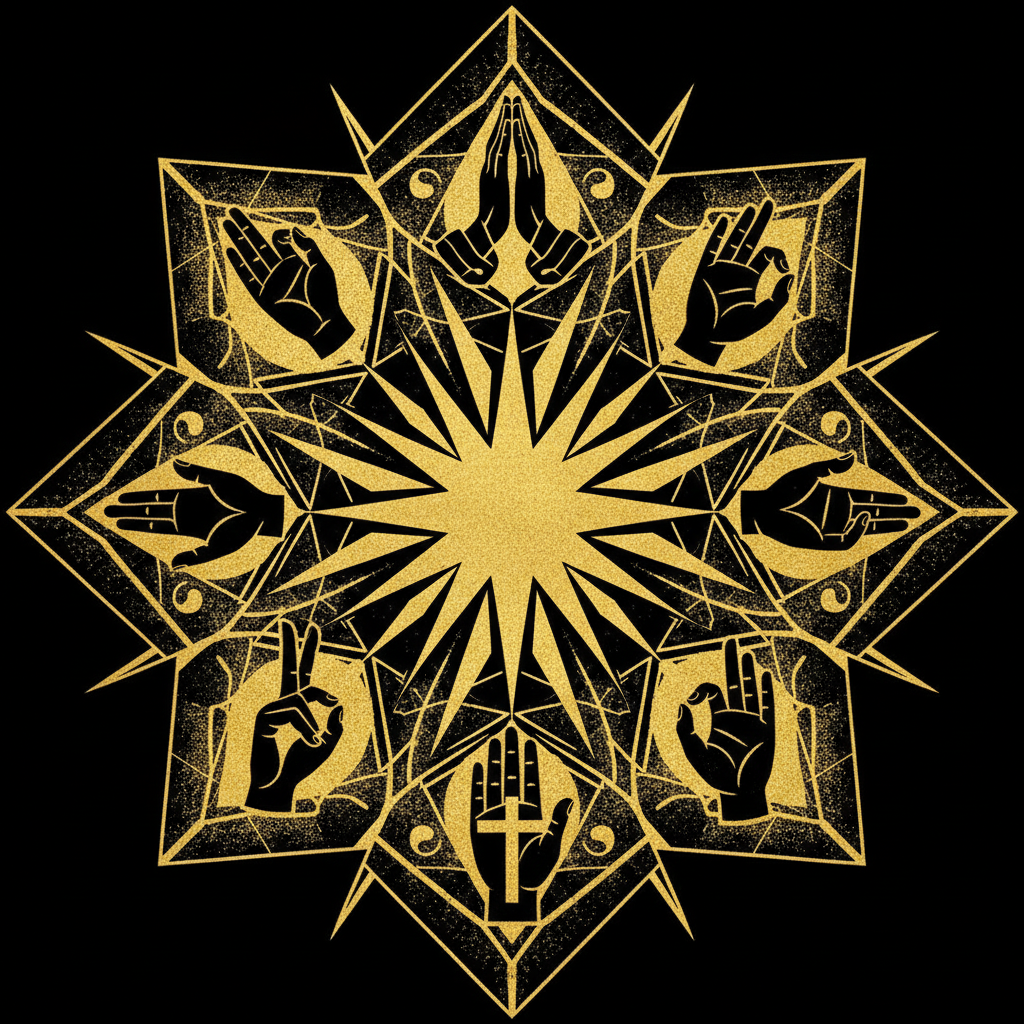
The second is quieter. One hand raised, the other placed over the chest. Bill’s left hand on his heart, Ted’s right. It’s almost reverent. Less active, more sincere. If the air guitar is a celebration, this is an acknowledgment. I see you. We’re connected. This matters.
Both are mudras in their own way… symbolic gestures that embody a truth. One for joy, one for presence.
And in the future… everyone does it.
When Bill and Ted travel forward in time, they see the world they helped create. And the people there greet each other with a softened version of the air guitar.
Not the wild, thrashing celebration Bill and Ted invented. Something gentler. An air strum.
It’s as if the world took their two gestures (the joyful air guitar and the sincere hand-on-chest) and fused them into something new. A universal greeting. A shared ritual that carries both joy and reverence.
That’s what happens when a practice spreads. It adapts. It softens. It becomes accessible to everyone, not just the originators. The meaning stays; the form evolves.
You probably have your own version. For me, it is a peace sign and shaka when I say goodbye. I’m not sure why or when I started doing it, but it feels right.
Maybe for you it is a nod. A hand on someone’s shoulder. A sincere handshake. The gestures are everywhere once you start looking.
Christians make the sign of the cross.
Muslims place their right hand over their heart after a handshake.
Hindus bow with palms pressed together in namaste (“the divine in me honors the divine in you”).
Jews touch the mezuzah when entering a home.
Buddhists offer anjali, palms together at the chest.
Sikhs greet each other with folded hands and “Sat Sri Akal” (truth is eternal).
Quakers sit in silence together… the absence of gesture becoming its own gesture.
We develop these rituals without planning them, and they come to mean something precisely because we keep doing them.
That’s the practice. Not grand declarations. Small gestures, repeated. The daily work of being excellent to each other, expressed through the body.
Everyone Plays
The ending of Face the Music stays with me.
You already know what happens… everyone plays. Every human being, across all of history, is participating in the same moment.
But here’s what I keep thinking about:
No one is left out.
Not the people who got it wrong.
Not the ones who showed up late.
Not the ones who didn’t believe until the last second.
Everyone. Playing their part.
Not the same part… their part.
I don’t know if that’s possible.
I don’t know if we’re capable of it.
But I know it’s a better direction than the one we’re currently heading.
The Invitation
So here’s where I land…
“Be excellent to each other” is a joke that isn’t a joke.
A philosophy that pretends not to be a philosophy.
A spiritual teaching delivered by two guys who would never call it that.
It’s survived 35+ years because it’s true.
Not complicated true.
Not footnotes-and-qualifications true.
Just… true.
Be excellent to each other. And party on, dudes.
That’s it.
That’s the whole thing.
Station.